Ready for New Adventures: Teaching Safety Skills Before Preschool
Safety sills
Parenting
ABA Therapy
Family
Self-care

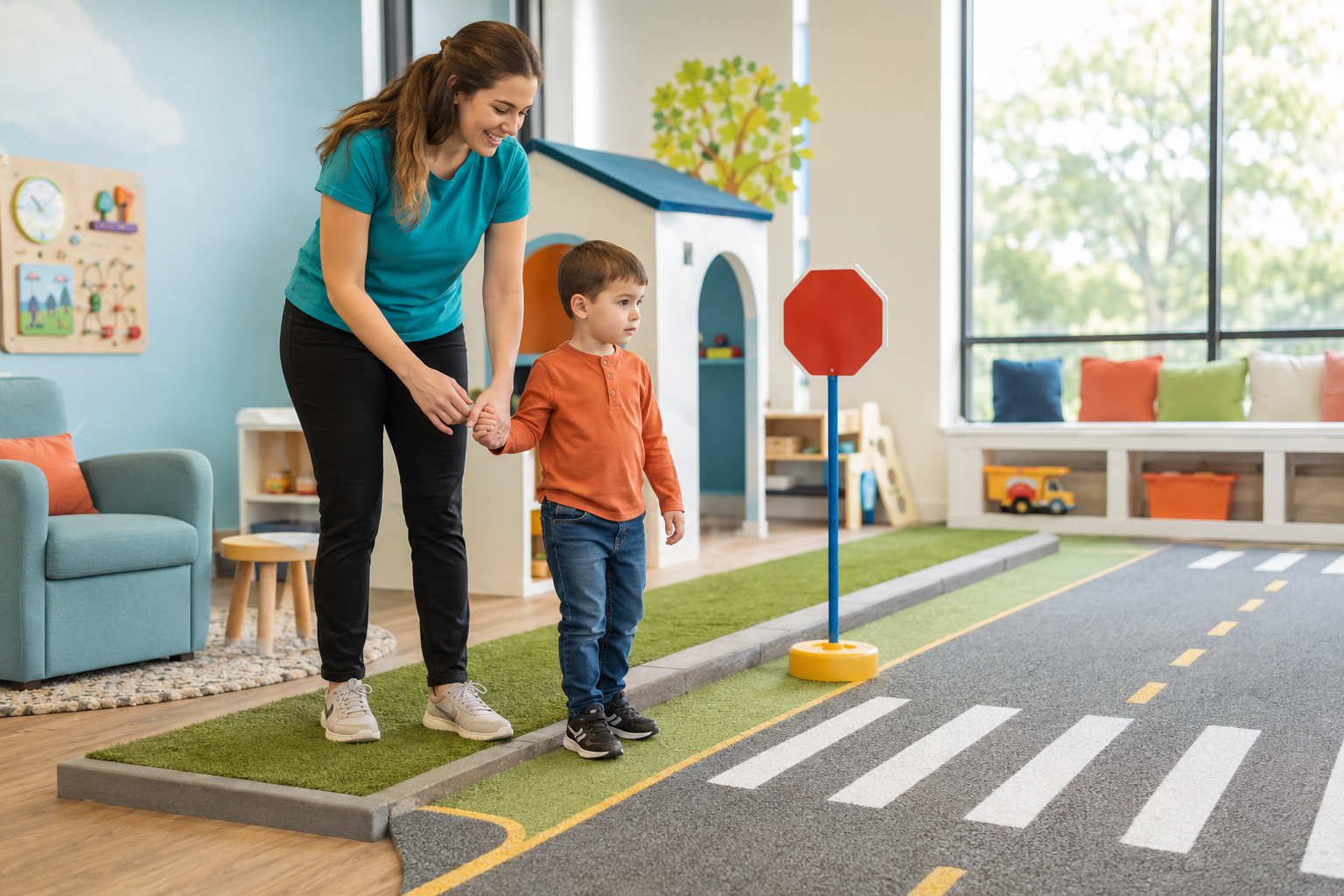
Trips to the playground, walks through the neighborhood, and visits with family can be exciting experiences for young children. They also introduce important safety expectations, such as staying close to an adult, stopping near a street, and responding when a caregiver calls.
Children with autism may benefit from additional support and repeated practice while learning these skills. Center-based ABA therapy provides structured, individualized opportunities to practice safety behaviors before children enter preschool and participate in more activities outside the home.
Safety instruction should reflect each child’s age, communication abilities, developmental level, and individual needs. For very young children, therapists may begin with foundational skills such as:
These skills take time to develop. They should always be practiced with appropriate supervision and should never be treated as a replacement for adult safety precautions.
In a center-based setting, therapists can break a safety skill into small, manageable steps. For example, responding to “come here” might begin from only a short distance away in a quiet room. As the child becomes more successful, the skill can be practiced in other areas and with carefully introduced distractions.
Therapists may use modeling, visual supports, prompting, repetition, and positive reinforcement. Support is gradually adjusted as the child develops greater confidence and independence.
Learning safety skills can be fun. Games such as Red Light, Green Light; Simon Says; and family scavenger hunts can help children practice stopping, listening, following simple directions, and remaining near an adult.
A center-based program may also incorporate safety practice into play, movement activities, transitions, and supervised walks within the clinic. This allows children to work on safety skills throughout the day instead of only during a formal lesson.
Communication is an important part of safety. A child who can request help, indicate discomfort, or ask for a break has an additional way to navigate challenging situations.
ABA therapy can help children develop functional communication using the method that works best for them. This may include spoken words, signs, gestures, picture-based communication, or an augmentative and alternative communication (AAC) device.
A safety skill is most useful when a child can demonstrate it with different trusted adults and in different environments. Therapists and caregivers can work together to determine how a skill should be practiced at the center, at home, and during carefully supervised outings.
Consistency is important, but safety practice should always be developmentally appropriate and supported by close adult supervision.
Learning safety skills is an ongoing process, especially during the years before preschool. Every small step—pausing when asked, reaching for an adult’s hand, or communicating a need for help—can become part of a stronger foundation.